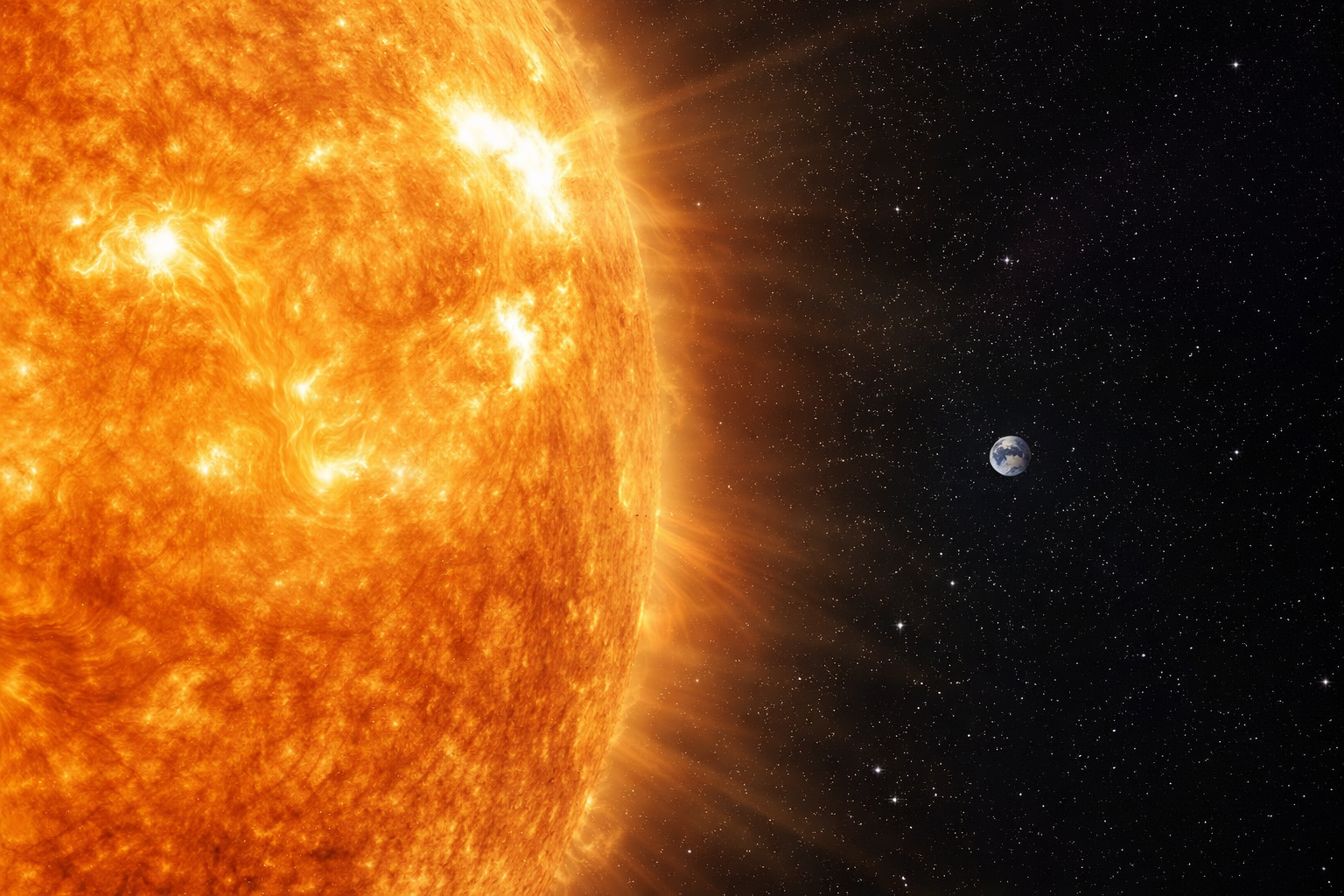
Every hour, enough sunlight hits Earth to power the entire world for a year.
Scientists estimate that Earth absorbs around 3.8 million exajoules of solar energy every year. Humanity, by comparison, uses roughly 600 to 700 exajoules in total.
In other words, the sun delivers thousands of times more energy than the world actually needs, every single year.
The problem has never been a lack of energy. The problem has always been that we’ve been standing under it and not catching it.
We live on a solar-powered planet
The sun is already doing the work. It heats the oceans, drives the winds, powers the water cycle, and grows the plants that become food. Beer is solar powered. The peanuts you eat with it are solar powered. Clothing. Music. Dogs. Cats. And you. You are solar powered. You’re basically a walking solar device in a nice pair of shoes.
What I’m saying is, you follow the energy chain far enough, almost everything you touch, eat, wear, or use is solar powered, either directly or indirectly.
And almost every energy system on Earth is, directly or indirectly, powered by solar.
For over a century, our civilisation has been fuelled by burning the past — coal, oil, and gas, each one a fragment of ancient sunlight trapped underground.
Essentially, we forgot to look up! From a physics point of view, that’s real… strange.
Now zoom in to Guernsey
Guernsey receives over 1,800 hours of sunshine per year, giving the island around 14 percent more solar potential than the UK average.
That means, day after day, year after year, an enormous amount of usable energy is landing on:
Homes
Warehouses
Offices
Schools
Farm buildings
Garages
And that’s whether we capture it or not.
From an engineering perspective, this is extraordinary. From an opportunity perspective, it’s almost comical. All that clean, usable energy arrives on the island for free and we’re still not yet taking full advantage of it.
The fastest energy shift in human history
Solar is no longer an alternative. It is now the fastest-growing source of electricity on Earth. Global solar capacity has grown more than tenfold in the last decade, and in most parts of the world, it is now the cheapest new form of power generation.
This isn’t a trend, it’s a structural shift, and it’s no longer a question of if solar becomes dominant. It’s a question of how fast each place joins the curve.
The truly strange thing isn’t that solar works. It’s that for decades, we built homes, towns and energy systems as if the sun wasn’t there. We designed buildings that ignore the largest energy source available to them. And yet, every solar installation is a small act of realism. A recognition that we live on a star-powered planet, and it finally makes sense to design our homes and our societies accordingly.
From a physics point of view, it was always inevitable.
From a Guernsey point of view, it’s one of the biggest untapped opportunities sitting right above our heads.