
How One August Day Delivered Near-24-Hour Solar Power
During the summer months, a well-designed solar and battery system can do something remarkable, it can turn sunlight into a near-continuous energy source.
Long days and strong solar generation mean that, for some homes, energy produced in the middle of the day is not only covering immediate demand, but is stored and reused to power the home right through the evening, overnight, and into the following morning.
This case study looks at a real August day, using measured system data to show how Self-Consumption mode allows a home to operate on close to 24-hour solar, dramatically reducing reliance on the grid while maintaining normal day-to-day living.
What follows isn’t a projection or a simulation.
It’s how the system actually behaves in real life, minute by minute, in the height of summer.
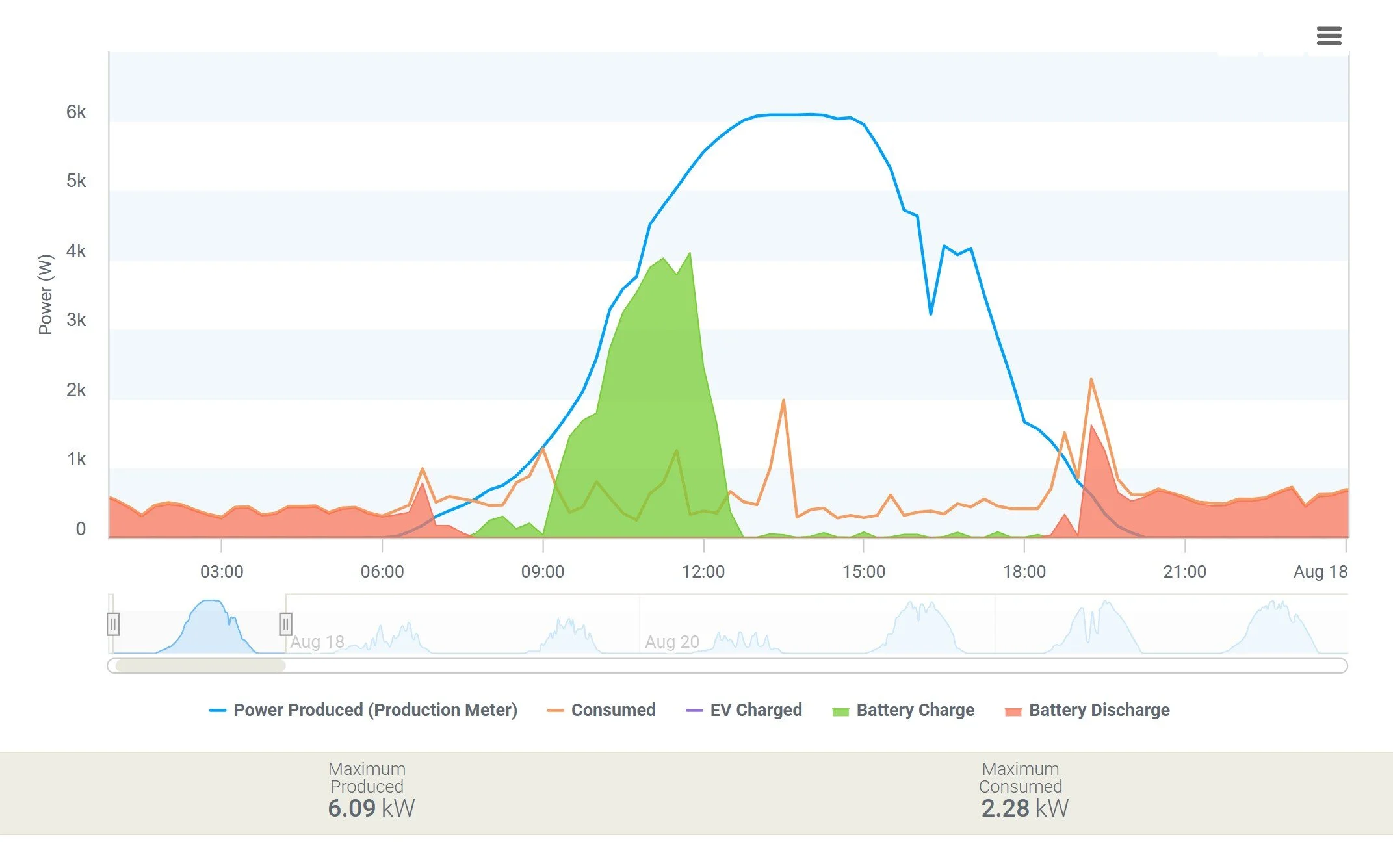
The System at a Glance
From the data:
Peak solar production: ~6.1 kW
Peak household consumption: ~2.3 kW
Battery charging strongly during peak solar hours
Battery covering overnight and evening demand
Minimal grid import across most of the day
This is the system behaving exactly as designed.
Overnight & Early Morning: Battery-Led Supply
In the early hours of the morning, household consumption sits at a low, steady baseline, typically covering essentials such as refrigeration, standby loads and background usage.
From the data we can see:
Solar production is zero
The battery is discharging to meet household demand
Grid import is effectively avoided
Rather than relying on the grid overnight, stored solar energy from the previous day is still being used to carry the home through to morning.
This is a key benefit of battery storage in summer, it allows solar energy generated yesterday to power the home today.
Morning: Solar Takes Over Seamlessly
As the sun rises and solar production begins to ramp up:
Battery discharge reduces automatically
Solar starts contributing directly to household demand
The transition is smooth and invisible to the homeowner
There is no abrupt switching or user control. The system continuously balances supply and demand in real time.
Late Morning: Self-Consumption in Full Flow
From around 8:30–9:00am, solar production exceeds household demand.
At this point:
The home is powered fully by solar
Excess energy is diverted into the battery
Battery charging ramps up quickly
Rather than exporting energy immediately, Self-Consumption mode prioritises storing it for later use.
Midday: Capturing the Solar Peak
Between mid-morning and midday:
Solar production continues to rise towards ~6 kW
Household demand remains modest
Battery charging peaks at close to 4 kW
This is the system capturing the most valuable solar energy of the day and storing it for evening use, instead of sending it back to the grid.
Early Afternoon: Battery Full, Home Secured
By early afternoon:
The battery reaches full charge
Solar production remains high
Household demand continues to be met directly by solar
Only once the home is powered and the battery is full does the system allow export to the grid.
Energy independence comes first.
Evening: Stored Solar Powers the Home
As the sun sets:
Solar production drops away
The battery begins discharging again
Household consumption is covered by stored solar energy
From the data, you can see the battery discharge closely tracking household demand.
This is the battery responding to real-world behaviour, not assumptions.
Night: Completing the Daily Cycle
Later in the evening:
Battery continues to take care of the homes consumption
By this point, the home has:
Used solar energy in real time
Stored excess generation
Re-used that energy overnight and into the next day
What This Day Shows Clearly
This August day demonstrates Self-Consumption mode working as intended:
Solar energy is prioritised at all times
Stored energy is used intelligently across day and night
Grid reliance is reduced to zero
The system adapts continuously to real household demand
The Takeaway
Battery storage doesn’t just shift energy from day to night.
It turns solar into a 24-hour resource.
What Comes Next
Summer shows what’s possible when the sun is abundant.
But energy independence doesn’t end when the days get shorter.
In our next case study, we’ll look at autumn and winter performance, exploring how the same system adapts when solar generation is lower. We’ll show how intelligently charging the battery during off-peak grid hours, then combining that with daytime solar, can deliver further savings, reduce peak-time demand, and play a role in supporting the grid rather than straining it.
Different season. Same principle.
Smarter energy, all year round.